Saturday, 17 October 2009

Lanark Tup Sales, sun shines on the turbine


Lanark Mart: RING 1 in full swing.


An important part of the farming calendar is making sure you have the right number of tups (rams) and that they are fit and healthy for the tupping season (which starts in November).

Inevitably you may need to replace some of the older ones and it is always good to introduce some new blood to the flock, perhaps some improved breed characteristics too. So, to this end, this week we went to buy some new tups at the Blackface tup sales held annually at Lanark Market.

This is an all day event. Before the sale starts, everyone wanders around the Penning Areas - looking at what is on offer. Alot of time and effort goes into ensuring the stock look their best for the sale. Every animal has been shampooed, preened, brushed and shined, made to look its best. Dyed wools, neatly clipped, oiled horns, clean feet and legs, horns branded with their unique number, any blemishes carefully concealed. These guys have never looked so good.


Each pen of tups has the name of the farm on it - with all the mystique of a vineyard. Names well known in the Blackface Sheep Breeders world - Allanfauld, Dyke, Troloss, Midlock to name but a few. Reputations formed over years and generations.

To the uninitiated like me I am ashamed to say - a tup is a tup is a tup. I am not sure I can tell a prize winner from a loser but those in the know, will know - and can hazard a guess at who might sell a tup for the highest price.

There are 2 sale rings. To sell your tups through ring 1, you have to have reached a certain average price in ring 2 at previous sales. This is enough of a hint for us to know that we will stick in ring 2 for our selection.

Early on in the day there were not so many buyers around, but during the course of the day the market filled up, like a huge party slow to get going. By mid afternoon the whole place was buzzing - both rings busy, and great chatter in the bars and restaurant - deals being done, acquaintances being renewed, hands shaken, laughter shared and a great kindred atmosphere. Buyers come from all over Scotland and northern England - we weren't the only folk from the Isle of Mull there, and I heard the auctioneer calling out names from the Isle of Skye too.

So we spent most of the day in ring 2, except for recreational visits to ring 1 to see if any exciting prices were being reached (£17,000 was one we heard!). By mid afternoon we had bid considerably less for 6 average but healthy looking tups -including one from Chirmorrie - no. 533, whose 'pedigree' you can see here.


At the end of the day, the tups were loaded into a lorry bound for Mull and we made our own separate way home.


We got home to brilliant sunshine and clear skies - wonderful October holidays weather.

One or two neighbours have been over to look at the turbine already. We do enjoy showing people round the turbine, the woodchip boiler and where the conversations lead; and we are happy to show our holiday cottage guests round if they are interested. Here she is, looking towards Calgary beach.


Tuesday, 13 October 2009

Our turbine is turning


On Monday afternoon the long anticipated Proven 6kW turbine finally arrived! And it looked huge lying there in bits on the back of a heavily laden pickup. The pickup drove gingerly into the field, up a non existent track to the site above the cattle shed.


The installers, 2 from Turbine Services and 1 from On Site Generation, worked away from 8.30 this morning, with Farmer and tractor on hand to lift and move the heavy components as and when required.


The tractor lifted. The pole sections were fitted into its 15m length. Internal workings were assembled. The generator was attached. More components were added. It was winched up using a Turfer. We watch with interest - we will be doing this the next time when it needs a service. By midday it was vertical!


It was bolted down.


By 4pm it was spinning. Electrics were installed. Controls were adjusted. It was ready to generate.


By 6pm we were using our own electricity and exporting to the grid.


So there it is - one Proven WT6000 wind turbine, on a 15m pole, standing elegantly above the farm steading poised to help reduce our carbon footprint. Using our own Renewable Energy will make the office and laundry for the Treshnish and Haunn Cottages more eco friendly, it will provide electricity for the Studio holiday cottage and the rest of the steading building. We had wanted to supply the woodchip boiler (pictured above with the turbine) as well, but it wasn't possible to wire everything into the same supply so its requirement is provided by the national grid.

It is going to take a while for all this to sink in, but finally we have turned the wind resource here into something positive and empowering!


Sunday, 4 October 2009

Ferries, cows and sunshine. And the ducks.


And after yesterdays storm.... Calm skies. Full warm glorious October sunshine. Fresh clean air.


The cows wait to move fields, near the Treshnish Cottages, and the Calmac ferry out to Coll has a flat calm crossing.


Call ducks sunbathe on the doorstep.


Saturday, 3 October 2009

Alice, the sea eagle and the storm


This is Alice.

This years favourite pet lamb, Alice, grew up yesterday.

We had found her on Treshnish Point, at lambing time, abandoned by her mother and very chilled, nearly dead. After a spell in front of the Aga and bottled colostrum she revived, and once she had recovered sufficiently she left the kitchen and joined the other orphan lambs for a diet of bottled milk and special attention from everyone around. What will we use instead now we have got rid of the oil fired Aga we used for lamb warming before?!

Over the summer she enjoyed her elite status as family pet - her ears would prick up at the sound of her name and (latterly) if she could be bothered she would come over to say hello.

This is one of Alice's "I cant be bothered to come over to say hello' moments.

Yesterday however, it was deemed time for her to join the other hoggs, so she was given her ear tag, identifying her as one of the 2009 lambs from this farm holding, and sent off to the Haunn field, where the others are grazing, in front of the Haunn Cottages. A Sea Eagle flew overhead as Farmer returned home.


Possibly one of the poorest photographs of a sea eagle ever taken - yesterday afternoon, as the storm (see below) began to build up at sea.

As I write there is a Severe Storm Force 10 wind blowing. Not surprisingly, we did not have the usual Saturday morning sighting of the Tiree ferry heading west across our view this morning, as it and many others have been disrupted today.

The storm is very dramatic, very exciting! Somehow you expect a storm to be dark and threatening but the light is bright today and clouds scud across the sky - every now and then giving us a blast of brilliant sunshine and sharp blue sky! The sea is a deep deep turquoise. Molten metallic turquoise with whiter than white waves cutting across the rolling tops of the swell. This will take the last of the leaves from the brave bendy sycamore trees around the farmhouse. The four lots of guests who arrived yesterday will be able to watch the storm from the cosy warmth and shelter of the Treshnish Cottages, as the centralised woodchip boiler belts out the heat despite the wind and sends it effortlessly underground to the holiday cottages and the farmhouse.


The sunshine and the storm, looking towards Calgary.

October is a great month to visit the isle of Mull. The island is beginning to quieten down, and prepare for winter. The weather can be stormy, like today, but it can be fantastic too! It will probably be calm and still and bright tomorrow!

The hills are changing colour as the bracken turns to reds and oranges, and the Red Deer stags are roaring. Out walking on the hill at Treshnish, you may well encounter a group of deer - and if the wind is in the right direction you can come across them at closer range. (During the stalking season it is good to check in the Access on Mull leaflet before you go walking as to where stalking might be taking place to avoid conflict of interest! We have a copy for our guests in the Phone Room.) We have been hearing the powerful primal roar of the stags over on Ensay for a while now, it is an exciting reminder of the wild - right on our doorstep.


Tuesday, 22 September 2009

A new flock of sheep

After the bird and flower friendly summer grazing regime (Holding back some fields for ground nesting birds, allowing flowers to set seed before cutting silage) the in-bye fields can be in need of some harder grazing to clean up the pasture which creates a better habitat for the huge diversity of wild flowers to flower again abundantly next year.

For this reason, a few years ago, we began keeping a small flock of 'cast ewes' over the winter on the fields. 'Cast ewes' are the older sheep who need a bit more comfort than they would get out on the hill. Usually they are sold off Isle of Mull hill farms onto 'softer' mainland farms where they graze turnips and raise their lambs in more sheltered fields. But some island farms keep them back and lamb them on their better ground as we have been doing.

Traditionally the winter grazing of sheep on arable and dairy field rotations is called 'the golden hoof' principle - they fertilise neatly as they go! But our gold hooved 'cast ewes' can be alot of work to look after as they are not so used to the fields and perhaps need more shelter than we can give them. So for their sake and for ours, we decided to start a new flock - so we will sell the older ewes through Oban Market and we have bought 40 Cheviot Hoggs from a neighbouring Farm and a Croft in Dervaig.

As we are still organic we had to get a Derogation from SOPA to enable us to buy non-organic breeding stock. (You have to have a good reason. In our case, we had looked for organic Cheviot Hoggs and couldn't find any, not even in a small number such as this.) And it has to be better buying local.

If you decide to come and stay in one of the cosy Treshnish and Haunn Cottages over the winter you may well encounter our new flock of sheep when out walking below the Treshnish holiday cottages, perhaps when looking for the resident otter along the rocky shoreline near the ruin of the 'old boathouse'.

Monday, 14 September 2009

The base is done...

Our next Renewable Energy project is to put up a 6 kW Proven turbine to harness the wind. This has finally moved off the back burner onto the hot plate - and here we go... We have been lucky to get SRDP funding and everything is in place now to get started.

Our site is above the Treshnish Farm Steading, in an elevated windy site, and indications are that we will generate a respectable amount of energy from this small scale project. We are lucky to be able to something positive that we personally believe in, through our business.

The base plate hole and the anchor hole were dug last week. Now they needed to be set with a special cement mix to secure the base plate and the anchor plate.

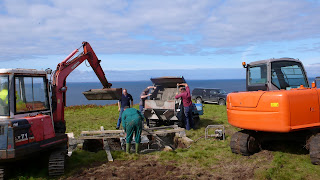
And today dawned dry if not too bright, and everyone was primed to be on hand to help. The turbine suppliers (jointly 'On Site Generation' from Edinburgh and 'Turbine Services' from Carlisle) were here to help the local team of Farmer and several experienced Helpers from Dervaig.


The first tracked dumper being unloaded - brought in from Dervaig.

The 2 ready mix lorries could only drive as far as the cattle shed. 2 local dumpers were going to carry the sloppy mix up to the site. This saved the human effort a back breaking amount of extra work.

The first dumper full of 'C35' concrete drives up from the cattle shed. The Isle of Coll in the distance.

The first lorry left and we waited for the second. From the turbine site we could see the road - and watched as the two lorries met on the corner towards Calgary and stopping for a chat. It was a lovely day and the view from the site is pretty amazing! We were watched at a distance by a pair of golden eagles at one point in the day.

The base plate suspended in the hole - recycled baler twine coming in useful again holding the grid mesh in place while the concrete was being poured in.

The seriously crucial thing is that the base plate stays level and in line with the anchor whilst the concrete is poured. It was a relief to us to have two guys here who has done this before! Some of the concrete was poured straight in, the rest was moved with our old digger bucket.


The digger bucket dropping concrete into the hole while the dumper pours as well.

There was a huge amount of human effort as well as the machinery but the job went well and much relief - a good job done! Now we must wait for the concrete to go off but Step one is finished. (SO exciting)

Thursday, 10 September 2009

This years lambs go.


It has been a beautiful day, fresh and warm, with wonderful blue skies at times and gentle soft autumn light softened by light spitty clouds. The fields around the steadings are full of sheep. Each field with a different group. Alot of bleating as the newly weaned ewe lambs are calling for their mothers and some mothers call back. Those with the strongest bonds walk each side of the fence. Most of them, though, concentrate on fresh grass and learning the new flock order.

At certain times of the sheep year, strange things happen (!) - sheep change name and become something other than what they were.

When the main draw of lambs are sold, for example, as ours were this week, the ewe lambs we keep back for breeding stop being lambs and become Hoggs as soon as those lambs are sold.


When these Hoggs are first shorn at just over a year old they become Gimmers.

The Gimmers then become Ewes after they have had their first lambs.

It gets more complex with the Tups (males), and half the time I m not sure who is who is what. (A Tup is what the English call a Ram) And they can be Wedders, Shearlings, a 1 Shear, 2 Shear and so on.

Tonight, with our lambs sold, the field of ewe lambs is now a field of Hoggs. And very noisy some of them.


During the first 5 months of their lives the Hoggs have instinctively learnt the lie of the land from their mothers out on the hill. This means that they are 'hefted' to Treshnish.

Hefting is the knowledge and sense of the place where the animals are born. They learn from their mothers where to find water, shelter, shade, the sweetest grazings. And when they return to the hill next spring they will make use of that knowledge and a year on will pass on the same knowledge to their own lambs. (You could not easily introduce 'foreign' sheep to an open hill like this - with 4 miles of dramatic unfenced coastline and lots of cliff edges, unhefted sheep would not know how to get around, and gathering would be a nightmare).

But for now the Hoggs will stay together for the rest of the year until the spring. They will be taught how to 'feed'. Eating delicious supplementary food (such as 'sheep nuts' or hay) does not come naturally to sheep and so it is necessary to teach them so that in later life if you bring them in for lambing you can supplement their diet accordingly.

The ewes go back to the hill now and will recover their body condition before the winter now that their lambs are not taking milk from them any more.

The next time the ewes will come through the fank is when they come into the in-bye fields to meet the Tups.

It is now dark outside - the evening is quiet. Lights shining warmly from the Treshnish holiday cottage windows, scent of woodsmoke in the air. Bleating and baa-ing from the fields beginning to quieten down. Mixed feelings seeing the lambs go but excitement too as a new season begins.